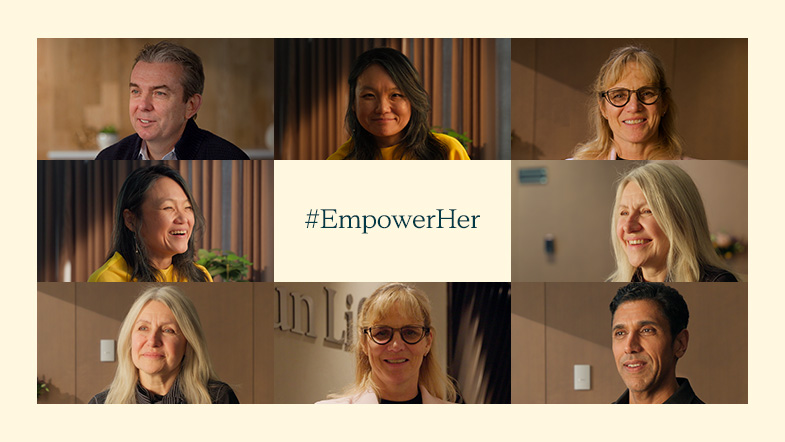
In conversation with Helena Pagano: Closing the gender health gap

[Music begins]
[Sun Life logo]
Helena: I am Helena Pagano, I am the Chief People and Culture Officer at Sun Life.
[Helena sits down in a chair in front of camera equipment. A man hands her a microphone to attach to her shirt.]
Super: Supporting women’s health could add 1.7 percent to global GDP.
[Helena Pagano Chief People & Culture Officer]
Helena: So, we know that women spend 24% more of their lifetime and poor health than men and that is a result of the underfunding and under research and Women's Health.
Super: 24% More time in poor health
Helena: Health issues go under-diagnosed.
Super: Under-diagnosed Under-supported
Helena: There’s not enough resources available to support women. That means they're coming to work, not feeling their best, stepping back from work, or not putting their hand up for opportunities.
[Helena clutches a Sun Life mug in her lap]
Super: Health impacts how women show up at work.
Helena: It’s important. It’s a business imperative. It’s so aligned to our purpose of healthier lives.
[Sun Life logo in office]
Helena: So, at Sun Life, we feel that hybrid work creates the flexibility that levels the playing field that lets women advance their careers.
Super: Flexibility levels the playing field
Helena: It gives them more time to address personal health issues or family issues while still creating the opportunity to make them feel they can put their hand up and take on that next opportunity or that career advancement.
[Helena gazes out of an office window and smiles]
Super: Changing how we talk about women’s health in the workplace.
Helena: At Sun Life, we've taken the opportunity to raise some conversations that previously were not had in the workplace. We started that conversation with menopause.
Super: All it takes is courage and conviction
Helena: All it takes is courage and conviction to have the first conversation.
[An office plant in the sunlight]
[Helena regards an abstract painting in the office]
Helena: If that is the value of just opening the conversations, people feel better supported at work but are getting better healthcare from their healthcare practitioner.
Super: What a win, win
[Helena fades out]
[Sun Life logo]
[Music fades out]
For many women, health is not a single moment. It’s a series of life stages that are too often overlooked by the system meant to support them. From fertility to menopause, to the invisible weight of caregiving, these realities sit at the heart of the gender health gap.
Women spend 24% more of their lifetime in poor health than men. It’s a heavy load to bear – one that takes a physical toll and often prevents them from realizing their full career potential. Many women leave the workforce in their prime, turn down promotions, or reduce their work hours to care for loved ones or manage their own health.
The gender health gap costs women, their families – and the economy. According to the McKinsey Health Institute, closing the gender health gap by 2040 could represent:
$37 billion
annual opportunity for Canada
$1 trillion
annual opportunity globally
At Sun Life, we recognize the responsibility to help close the gender health gap. It’s an opportunity to step into a critical moment to advance better health outcomes and contribute to a significant economic market shift.
Helena Pagano, Executive Vice-President and Chief People and Culture Officer at Sun Life, has led the charge, with policies, resources and education that help us address the needs of female employees and create a workplace where everyone can thrive, feel supported and empowered to grow.
Supporting women at every life stage
Directly tied to our Purpose of helping people achieve healthier lives, Sun Life is supporting women’s health needs through all stages of life and phases of their career.
“Through information, tools, policies, manager training - a whole basket of things, we’re making sure people can achieve their best and manage through their health issues at every stage of their life,” says Helena.
For women early in their careers
Usually in their 20s and 30s, their health concerns are often fertility or infertility issues. These topics are woven into career conversations and supported by tools and resources.
For leaders in their 40s and 50s
We ensure that menopause resources are just as accessible as leadership development supports.
Throughout an employee’s career
We treat caregiving not as a career interruption, but as a life reality that requires flexibility and support.
The key to Helena’s work is that this support goes beyond providing information and resources to creating a culture that is open, supportive and inclusive – a workplace where women feel comfortable bringing their whole self and their whole health questions forward.
Speaking of menopause
An important way that Sun Life has created change is really the simplest: by talking and listening.
“We started talking about women's health and menopause in alignment with our Purpose, knowing that it was a topic that was not researched, not covered, not spoken about. We really wanted to bring the dialogue into the workplace,” says Helena.
Women over 40 are a significant segment of the workforce (in Canada they make up one-quarter of the labour pool). But more and more are leaving in their prime or taking a step back from their careers.
To create a workplace culture that is supportive of women’s career advancement, Helena knew there had to be a cultural shift, and that leadership had to be courageous and show that these conversations belong at work.
By hosting global employee sessions that elevate the conversation around women's health at work, including topics on menopause and fertility, Helena cultivates an environment that breaks down stigma and creates a safe space for open dialogue
“All it takes is courage and conviction to have the first conversation. And once we did… people started bringing their questions, their conversations about this, which created that safe environment and open culture,” says Helena.
Once this work began, she says, “employees would stop me inside the workplace, people would stop me outside and say, I just never thought that I could have this conversation. And it’s so great to feel supported.”
How going hybrid helps
Data shows us that women still carry most of the invisible workload in their personal lives. That includes not just the physical responsibilities of activities like household chores and childrearing, but also the cognitive work of anticipating, organizing and planning. These demands are significant and create stressors that can detract from their work experience.
To empower women to balance their professional and personal priorities and create healthier lives, Sun Life has implemented flexible work options, including hybrid work (combining work-from-home and in-office work) and care days.
“At Sun Life, we feel that hybrid work creates the flexibility that levels the playing field, that lets women advance their careers,” says Helena. “It gives them more time to address personal health issues or family issues, while still creating the opportunity to make them feel they can put their hand up and take on that next opportunity or that career advancement.”
Sun Life’s commitment is clear: we want every employee to have the right conditions to do well, feel well, and live healthier lives. By acknowledging women’s health realities, investing in the right supports, and fostering open dialogue, we’re working to close the gender health gap — and set a new standard for what a truly inclusive workplace looks like.